
What Is IDOC?
IDOC is the official abbreviation used by the Illinois Department of Corrections on its own public pages, including the agency home page, Individual in Custody Search, facility directory, reports, victim services, and FOIA material. The agency operates the Illinois state prison system. It is not a county sheriff, a county jail vendor, a circuit clerk, BOP, or ICE.
The IDOC inmate population includes people committed to Illinois state custody after sentencing, people in reception and classification, people in prison treatment centers, people assigned to work camps or minimum-security units, and people in adult transition or reentry settings. County jails hold the local side of custody, including new bookings and pretrial detention. That is the most common reason an IDOC locator search returns no result for a recent arrest.
The IDOC home page is the official agency page for Illinois corrections context.
The agency branding confirms the IDOC abbreviation used in the URL, title, heading, and statewide prison content.
The IDOC Inmate Population
The March 31, 2026 IDOC public prison population workbook contains 30,251 searchable public individual-in-custody rows after the workbook's confidentiality removals. The June 30, 2025 public workbook contains 29,290 comparable rows. The public dataset therefore increased by 961 rows, or about 3.3 percent, over that comparison period. The numbers should be described as public row counts because IDOC notes that some records are removed from public extracts for confidentiality.
| Measure | Figure | Source |
|---|---|---|
| IDOC inmate population public rows | 30,251 | March 31, 2026 IDOC prison population workbook |
| Comparison public rows | 29,290 | June 30, 2025 IDOC prison population workbook |
| Change | +961 rows, about +3.3 percent | Research comparison of official IDOC datasets |
| Largest listed parent institution | Menard, 2,004 rows | March 31, 2026 public dataset |
The IDOC prison population data sets page is the source for current public workbook counts.
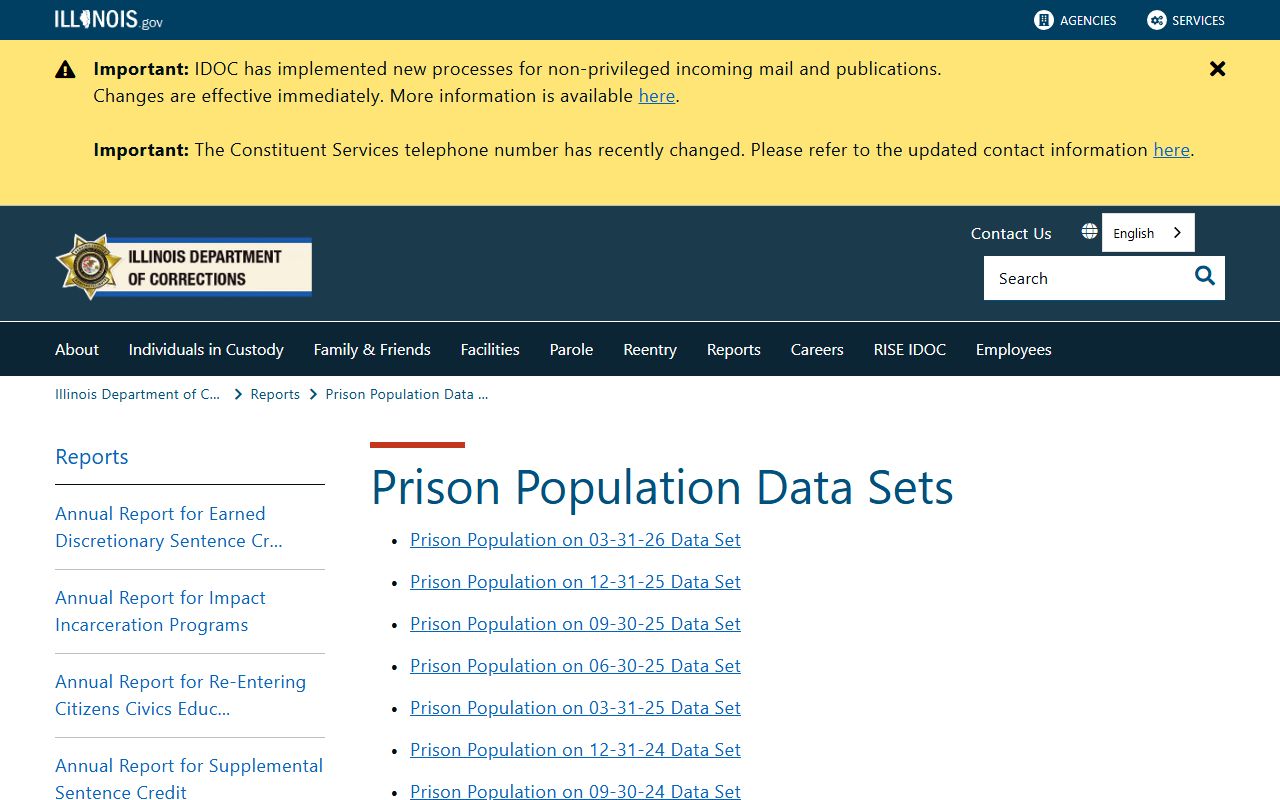
Those workbooks are the right source for IDOC prison population trends, not county jail roster totals.
How to Search IDOC Inmates
The official IDOC Individual in Custody Search starts at the current state landing page, then links into the legacy search form. The legacy form supports last-name search, IDOC-number search, and birthdate search. IDOC numbers in the research source appear in a letter-plus-five-digit format, such as A00147 or Y74648. A name search is broader, while an IDOC-number search is more exact when that number is available from a court document, jail transfer note, prior profile, or correspondence.
- Open the official IDOC Individual in Custody Search landing page.
- Continue to the state-linked legacy search form if the landing page routes there.
- Search by last name, IDOC number, or birthdate based on the information available.
- Open the matching profile and read the parent institution, status, sentence fields, projected MSR date, and projected discharge date.
- If no result appears, check county jail, BOP, ICE, court, and VINELink channels before assuming the person is not in custody.
The IDOC Individual in Custody Search landing page is the official statewide locator entry point.
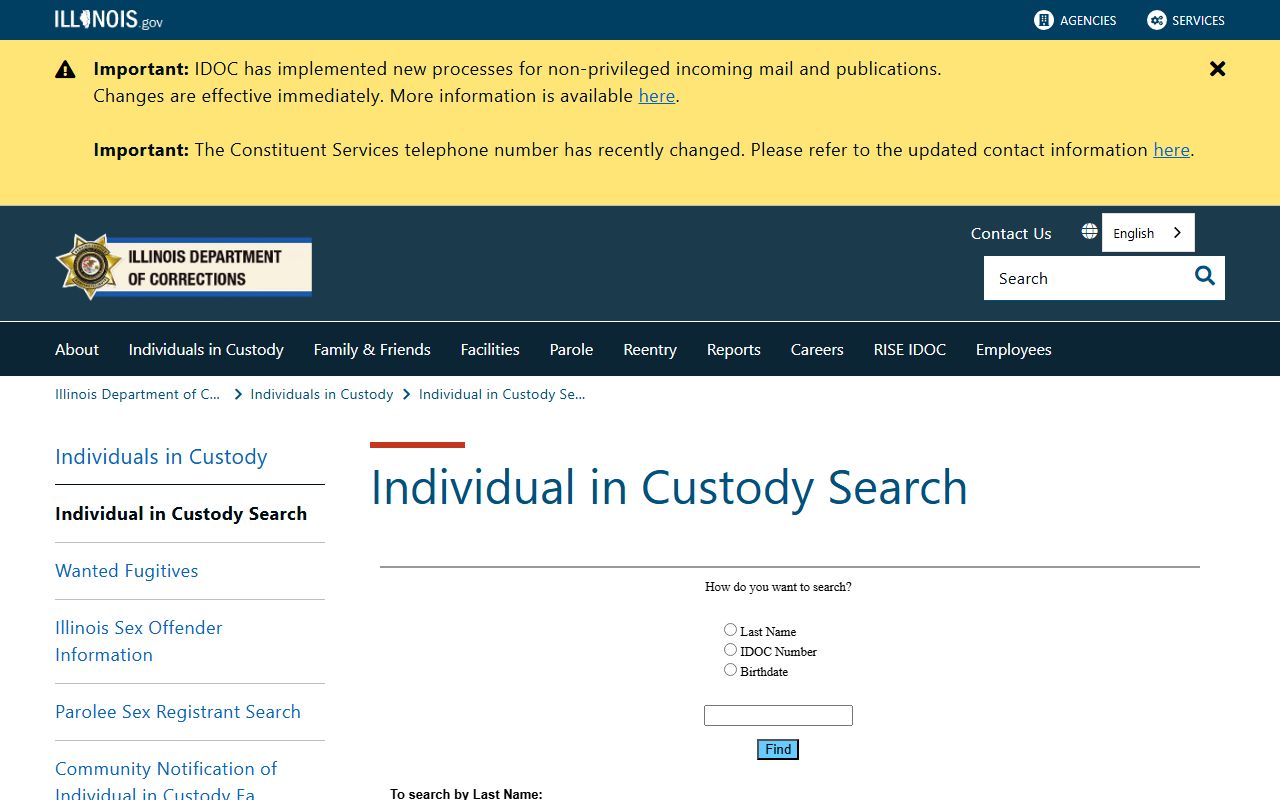
The landing page is the correct starting point for sentenced Illinois state prisoners and IDOC custody records.
The legacy IDOC search form shows the three main search options used by the public locator.
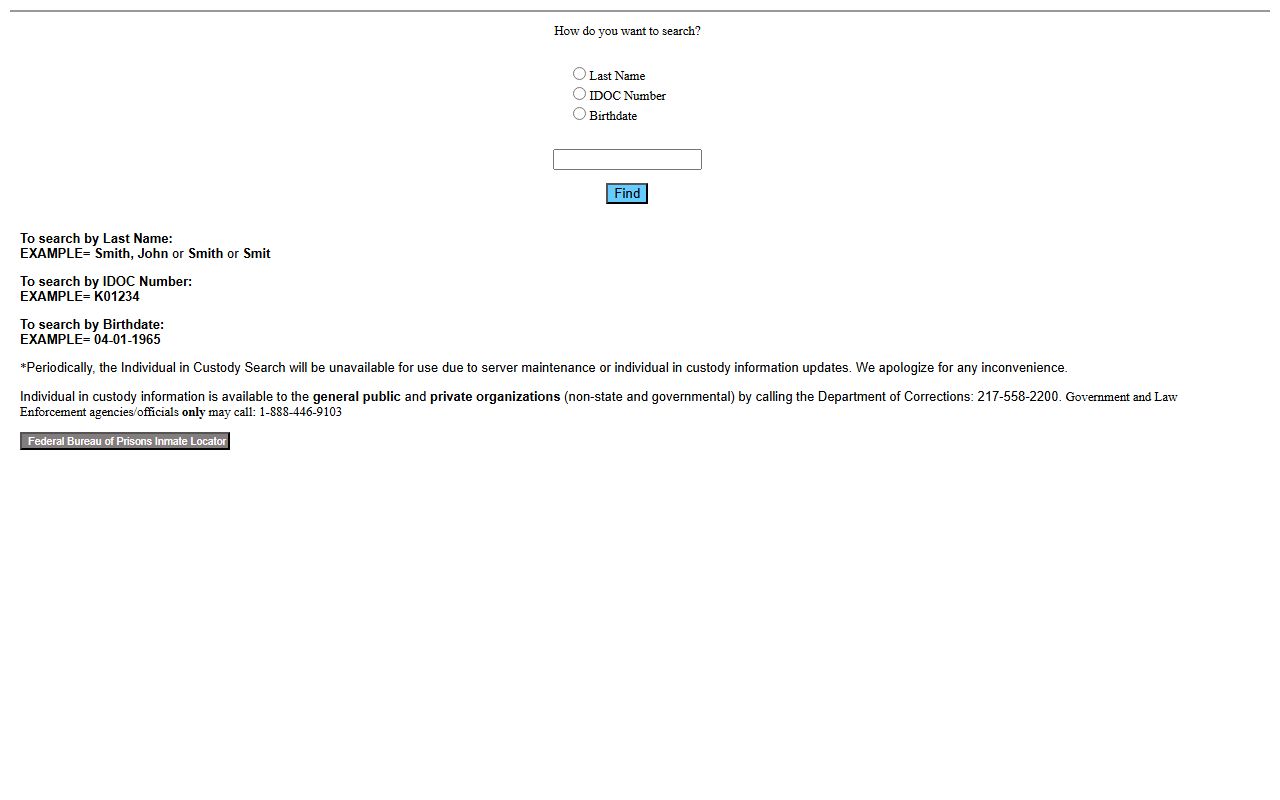
Those fields are different from county jail roster fields, which are set county by county.
IDOC Inmate Record Fields
An IDOC public profile is a state prison record. It may show identifying and custody fields such as name, IDOC number, photo option, date of birth, sex, race, physical description, custody date fields, parent institution, admission type, projected mandatory supervised release date, projected discharge date, sentence information, and status. The population workbooks use Parent Institution rather than county jail housing unit, which reinforces that IDOC data is a state prison layer.
| Field | What It Means |
|---|---|
| IDOC number | The state corrections identifier used to distinguish people with similar names. |
| Parent institution | The IDOC facility or parent institution tied to the public record or dataset row. |
| Admission type | The general way the person entered IDOC custody or returned to custody. |
| Projected MSR date | The public projected mandatory supervised release date when shown. |
| Projected discharge date | The public projected date tied to sentence administration when shown. |
| Sentence information | Case, offense, term, or sentence fields that IDOC makes public and that may be redacted. |
IDOC Prisons and Facilities
IDOC facilities include major correctional centers, reception and classification centers or units, treatment facilities, work camps, adult transition centers, and reentry or life-skills centers. The statewide research identifies Big Muddy River, Centralia, Danville, Decatur, Dixon, East Moline, Graham, Hill, Illinois River, Jacksonville, Joliet Treatment Center, Joliet Inpatient Treatment Center, Kewanee Life Skills Re-Entry Center, Lawrence, Lincoln, Logan, Menard, Murphysboro Life Skills Re-Entry Center, Pinckneyville, Pontiac, Robinson, Shawnee, Sheridan, Stateville, Taylorville, Vandalia, Vienna, Western Illinois, and adult transition centers including Crossroads, Fox Valley, North Lawndale, and Peoria.
Security and program labels can change, so statewide copy should use a classification-based description instead of assigning a fixed level to every facility without facility-specific source text. Illinois uses parent institutions, reception and classification, specialized treatment, work camps or minimum units, impact incarceration, and reentry or adult transition settings. The Illinois facility directory lists the statewide roll-up and points to county subdomains for facility pages.
The IDOC all-facilities directory is the official source for the state facility list and filters.
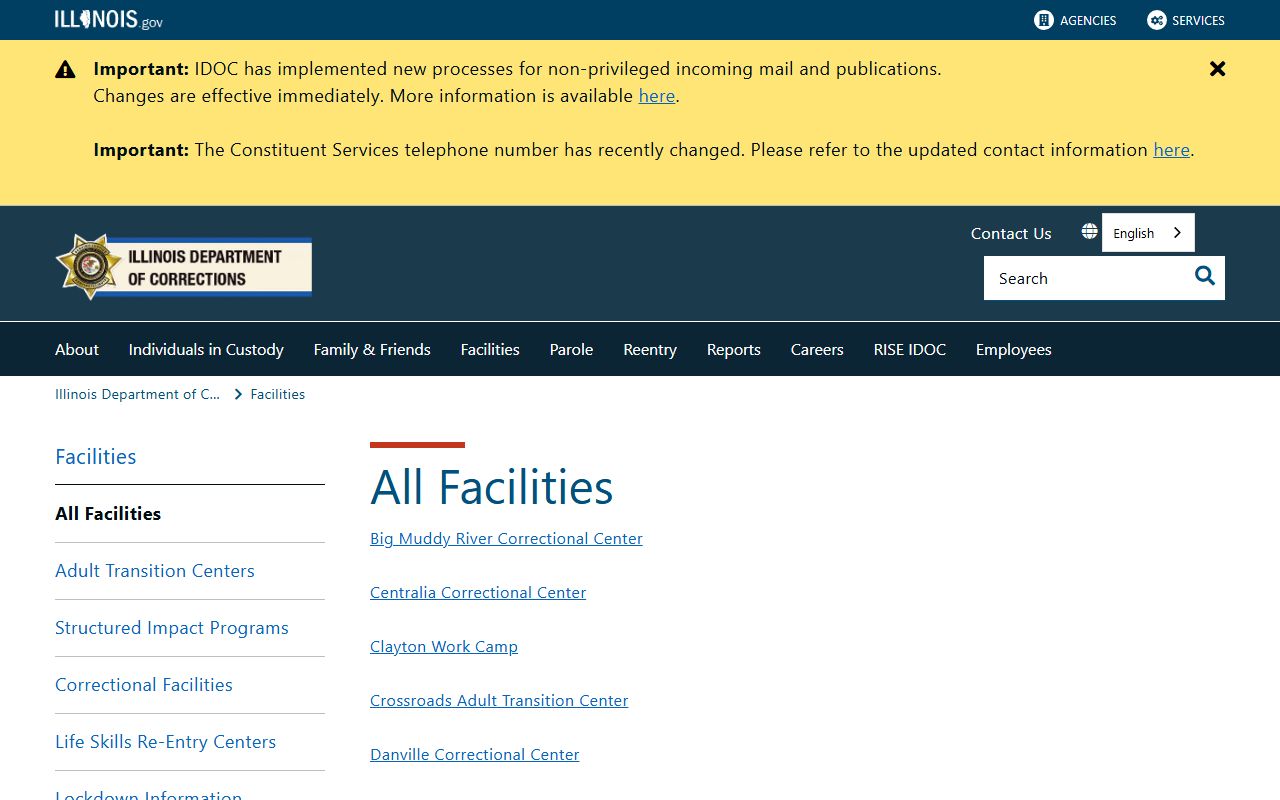
IDOC facilities are physically located in counties, but county sheriffs do not operate those state institutions.
IDOC Inmate Population Trends
The statewide public dataset rose from 29,290 public rows on June 30, 2025 to 30,251 public rows on March 31, 2026. Menard, Hill, Stateville, and Kewanee increased in the public dataset. Graham and Centralia declined slightly in the comparison. This movement should be presented as public dataset trend, not a full operational population audit, because IDOC warns that data elements remain subject to validation and that confidential records are removed.
| Institution | June 30, 2025 | March 31, 2026 |
|---|---|---|
| Menard | 1,872 | 2,004 |
| Hill | 1,380 | 1,612 |
| Stateville | 1,677 | 1,818 |
| Kewanee Life Skills Reentry Center | 195 | 232 |
| Graham | 1,802 | 1,789 |
| Centralia | 1,290 | 1,193 |
IDOC Sentencing and Release
Illinois release language differs from county jail release. A person may first appear on a county roster after arrest. If the case results in a prison sentence, the person is transferred to IDOC. Once in IDOC, sentence administration is controlled by the Unified Code of Corrections, IDOC rules and policies, the court's sentencing documents, and the Prisoner Review Board's role in parole and mandatory supervised release matters.
Illinois uses mandatory supervised release, often called MSR, for many prison sentences. IDOC public profiles and workbooks can show projected MSR and projected discharge dates. These are public projections, not guarantees. Sentence credit under 730 ILCS 5/3-6-3 can depend on sentence date, offense class, statutory exclusions, discipline, program participation, revocation, restoration, and IDOC or PRB decisions.
- MSR
- Mandatory supervised release is a post-prison supervision phase, not a county jail booking status.
- Sentence credit
- Credit can reduce time served, but eligibility is offense-specific and rule-specific.
- Projected discharge
- The public date is based on sentence data and can change when records or credits change.
IDOC vs County Jail
The IDOC inmate population is not the same as the Illinois county jail population. County jails hold pretrial detainees, new arrests, short sentences, warrants, holds, and transfer cases. IDOC holds people committed to state custody after sentencing. A person can move from county jail to IDOC after sentencing, and that transfer can create a delay before the public IDOC profile updates.
| IDOC State Prison | County Jail | |
|---|---|---|
| Custody stage | After state prison commitment | After arrest, while pending court, or for short local custody |
| Public search | IDOC Individual in Custody Search | County roster or local jail page |
| Records request | IDOC FOIA process | County sheriff, county FOIA officer, or local records unit |
| Common next step | Check PRB or court records for release context | Check court records after arrest for filed charges |
IDOC Records Requests
IDOC records requests route through the agency's FOIA process. FOIA is the correct path for agency records not displayed in the public inmate search, such as policies, statistical reports, inspection-related documents, and records subject to release after review and redaction. The public locator is the first step for current custody status, but it is not a full archive and does not replace a formal records request.
The research source found the IDOC FOIA page URL, but the screenshot capture failed for that page. The official route remains IDOC FOIA. Requests for county jail records should not be sent to IDOC unless IDOC created or controls the record. County booking sheets, local mugshots, county jail calls, and local jail logs usually belong with the holding county.
A precise request should name the record type and explain whether the requester wants a public profile, a statistical report, a policy, an inspection-related document, or a copy subject to redaction. IDOC may withhold protected material, and the public search may omit confidential people from datasets. That limitation is why population pages should cite the public workbook language and avoid treating every missing record as proof of release.
IDOC Jail Standards Context
IDOC also has a Jail and Detention Standards Unit. That unit provides statewide oversight, inspection, standards, population reporting, and compliance context for county jails. It does not mean IDOC operates county jails. For the apex site, this source is useful for statewide jail standards and capacity context, while county jail roster mechanics still come from each county.
The IDOC Jail and Detention Standards page explains the statewide standards layer for local detention.
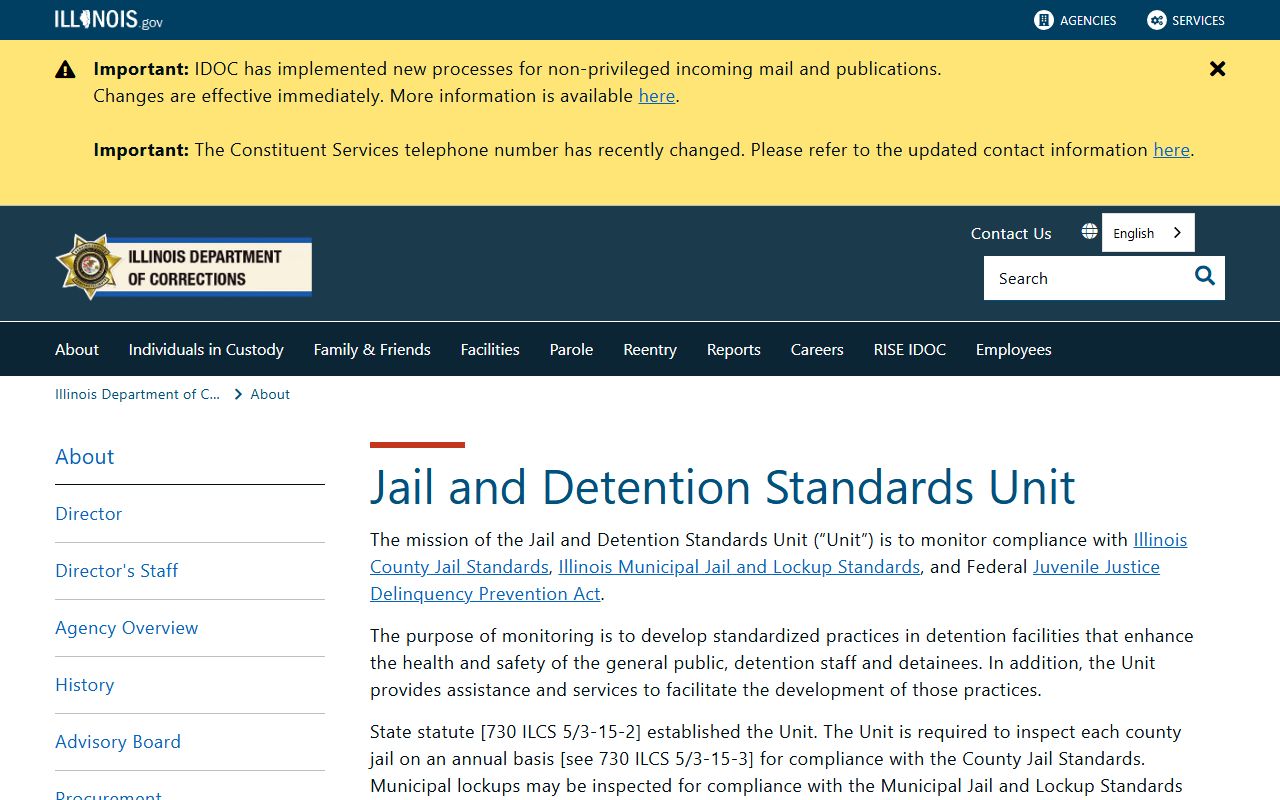
That standards layer supports statewide context without turning county jails into IDOC facilities.
Public Record Search
Sponsored Results